Biomedical instrumentation and measurement
How signals are acquired, conditioned and recorded, and how measurement systems are calibrated and validated. This theme underpins all other work on this site.
This page separates published work, research themes, proposed methods and unanswered questions. Each category is labelled, so that a hypothesis is never read as a finding.
The themes below describe the areas of interest. They are not claims of completed projects.
How signals are acquired, conditioned and recorded, and how measurement systems are calibrated and validated. This theme underpins all other work on this site.
The use of impedance measured across a body segment, and the prediction equations used to convert it into body-composition estimates. Study of its repeatability and assumptions.
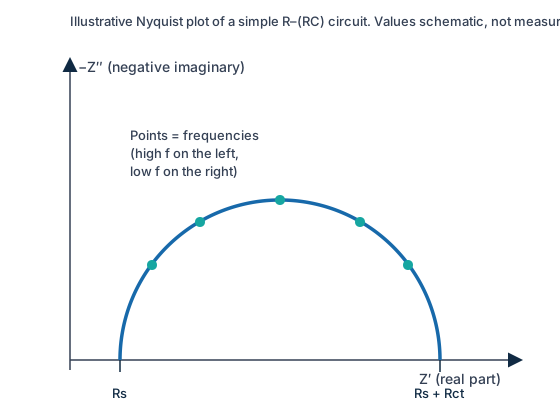
Impedance measured across a range of frequencies and analysed as a spectrum. Used in electrochemistry and materials science, and explored here as a method for biomedical measurement questions.
Protocols, reporting standards, blinding, confounding and statistics for studies that combine homoeopathy, clinical research and engineering measurement.
The author's academic background includes psychiatry and behavioural health teaching. Relevant published records are being checked and will appear in the archive once verified.
A reader should always know which category a statement belongs to.
| Category | What it means | Example on this site |
|---|---|---|
| Established principle | Widely accepted scientific or engineering knowledge | Impedance is the ratio of voltage to current in an AC circuit |
| Proposed framework | An idea put forward for discussion and testing, not yet established | Homoeo-bio-engineering as an interdisciplinary framework |
| Hypothesis | A testable statement, which may turn out to be false | A standardised protocol yields repeatable values in a given population |
| Published finding | A result reported in a verified publication, with its design limits | Preclinical results listed in the publication archive |
| Open question | A question with no established answer | Whether any measured change is clinically meaningful |
Only publications whose metadata has been checked against a publisher, PubMed or an author profile are listed in the archive. Other records are being checked and are not shown until verified.
The archive shows title, authors, journal, year, study type and a neutral summary. Each entry links to the DOI or PubMed record.
These questions are listed as directions for study. None is answered by this site.
A hypothesis states what a study would test and what result would count against it. Before a hypothesis can be supported, the study needs a pre-specified design, measurement plan and analysis.
Hypotheses on this site are presented with their test conditions. They are never presented as established conclusions.