Biomedical Instrumentation
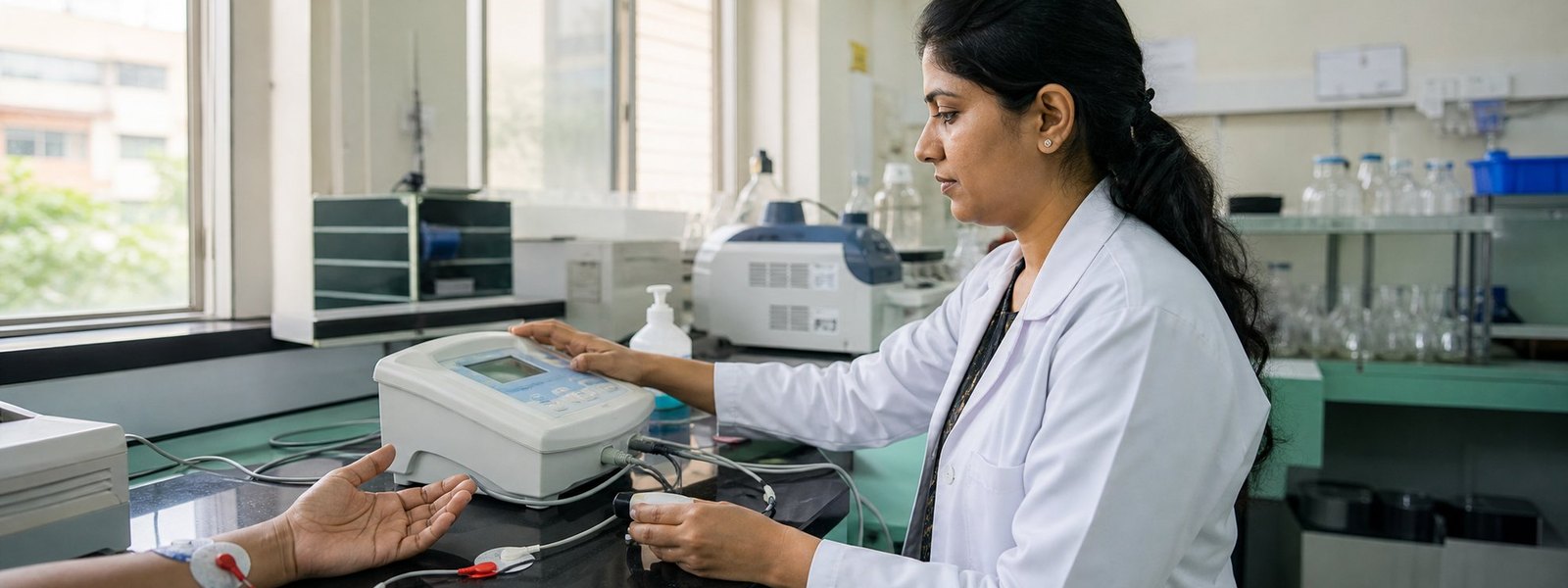
How measurement chains acquire, condition and record physiological signals, and how each stage is validated.
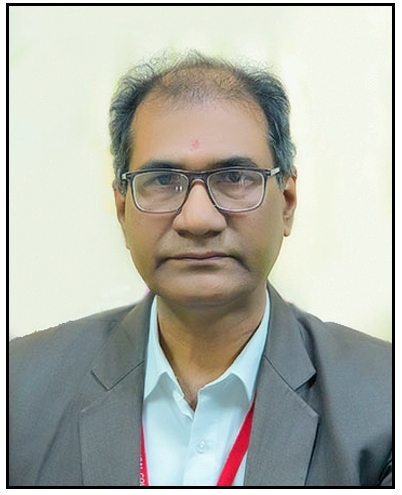
Dr. Mahendra Hariram Gaushal · Director / Principal, Sonajirao Kshirsagar Homoeopathic Medical College and Hospital, Beed
Academic profile · Research · Learning resourcesHomoeo-bio-engineering is proposed here as an interdisciplinary academic framework exploring biomedical engineering tools, physiological measurements and research methods in the study of homoeopathic interventions.
An independent personal academic initiative. Homoeo-bio-engineering is a proposed framework and is not an officially recognised discipline. Nothing on this site is medical advice.
Dr. Gaushal is a homoeopathic physician and academic. His published biodata records long experience in health science education at undergraduate and postgraduate level, together with research and academic administration.
His interests bring measurement science into the study of homoeopathic interventions. These include biomedical instrumentation, bioelectrical measurement, bioelectrical impedance analysis (BIA), electrochemical impedance spectroscopy (EIS), psychiatry and behavioural health research, and research methodology. The emphasis is on method, reporting and limitations.
Read the full academic profile or see the research themes.
Each theme links to a page with explanations, references and the limits of current evidence.
How measurement chains acquire, condition and record physiological signals, and how each stage is validated.
Estimating body composition from the impedance of a body segment, with its prediction-equation assumptions.
A broad-frequency spectroscopic method related to BIA but used under controlled electrochemical conditions.
Protocols, controls, blinding, confounding, repeatability and reporting standards for interdisciplinary studies.
The framework is proposed for discussion and testing. The four parts below are kept separate, so that established science, hypotheses, published findings and open questions are never confused.
Impedance, resistance, reactance, phase angle, instrument calibration and the statistics of repeatability are standard concepts in physics, engineering and clinical measurement. They are explained on the subject foundations page.
Hypotheses are testable proposals, for example whether a standardised BIA or EIS protocol gives repeatable values in a given study population. They are not conclusions. See the research gaps.
Only records with verified metadata are listed in the publication archive. Experimental results are described with their design limits, and are not treated as clinical proof.
Open questions include whether any measured parameter changes in a way that is reproducible, interpretable and separate from confounders such as hydration. These questions remain open.
Many questions about health interventions need a careful measurement method as well as clinical observation. Homoeo-bio-engineering proposes to bring engineering measurement standards into these questions, while keeping the homoeopathic and clinical context in view.
A bioelectrical impedance measurement applies a low-amplitude alternating current and records the voltage that results. The ratio of voltage to current gives the impedance magnitude, and the phase shift between them gives the phase angle.
These are established measurement principles. Converting an impedance value into a body-composition estimate, or into a statement about health, requires further assumptions, which is why the BIA and EIS page discusses limitations in detail.
Illustrative figures that show how impedance behaves. They are not data from any study.
Both records below were checked against the publisher or PubMed entry and the author's Google Scholar profile. Further records are being verified and will appear in the archive only once checked.
A preclinical study in a rat paw-oedema model. This summary does not restate the findings; read the paper for the authors' own conclusions and limitations.
A preclinical laboratory and animal study. This summary does not restate the findings; read the paper for the authors' own conclusions and limitations.
Downloadable PDFs and presentations will be listed here once the owner has authorised them. The items below are web-based lessons and reference pages.
Bioelectricity, physiological measurement, tissue properties, resistance and reactance, and research limitations.
What each technique measures, how they differ, phase angle, protocols and factors that affect repeatability.
Searchable, original definitions for impedance, reactance, phase angle, reproducibility, confounding factors and more.
These are questions for study, not established answers. Each one needs a pre-specified protocol and an appropriate comparison group before any conclusion can be drawn.
Biomedical engineers, biostatisticians, clinicians, researchers and academic institutions are welcome to propose seminars, workshops, research collaborations or joint project proposals. Each enquiry is reviewed individually. Contacting the site does not imply any partnership or endorsement.